Real Estate SEO Keyword Research: Mistakes That Start Before You Publish
A worked example of how demand, CPC, search results, page ownership, and internal links turn a real estate topic into an SEO decision.
Keyword research can fail while every column in the spreadsheet is correct.
The failure starts when a real estate business decides it needs a page, then asks the research to justify the decision. The subject sounds relevant. A tool returns related phrases. Someone chooses one for the title. The finished brief looks researched because it contains numbers.
But a plausible subject is still only a hypothesis. Search demand may be negligible. The people using the phrase may want a different kind of page. Two phrases that look interchangeable may serve different readers. Two phrases that look different may belong to the same page.
An export does not resolve any of that. Keyword research is complete when it supports a page decision: create, keep, rewrite, merge, or reject one URL, then explain how readers will reach it and where they should go next.
When the decision is wrong, the cost arrives after the spreadsheet: the brief, the copy, the design, the internal links, and the authority spent promoting a page that performs the wrong job. Repair can mean a rewrite, a merge and redirect, moved links, and another wait for search engines to process the change. Research belongs before the page because correcting architecture is more expensive than correcting a row.
This is ordinary SEO judgment. Real estate changes the business inputs and the search landscape. The underlying ranking system is the same.
Start with the real business
A keyword tool has no idea what the business can sell.
For an agent or brokerage, the useful seed set depends on the markets genuinely served, whether the business wants buyers or sellers, the property types it handles, the inventory and expertise it can support, and the conversion worth pursuing. A brokerage licensed in one state does not need a national pile of city keywords. An agent who does not handle rentals does not need rental traffic merely because the volume is attractive.
These constraints come before the export because they separate three markets that can share the same words: people looking for an agent, people looking for property, and agents looking for software or marketing help. The result page then tests what the query requires. If a map pack leads, the opportunity may depend on local visibility rather than another article. If national portals own the inventory results, a thin neighborhood guide will not answer the property search merely because it contains the city name.
Volume first does not mean highest volume wins
“Volume first” means measuring demand before finalizing the site architecture. It does not mean sorting a spreadsheet from largest to smallest and publishing in that order.
Consider a residential brokerage that genuinely serves Austin and can publish live inventory on its own site. A topic-first plan could put all three phrases on an “Austin real estate” page:
| Query | Est. US monthly searches | Est. CPC | Current top-result job | Page decision |
|---|---|---|---|---|
homes for sale austin tx | 22,200 | $3.10 | Browse live inventory | Austin inventory page |
austin realtor | 1,900 | $9.70 | Choose a provider; local pack present | Brokerage homepage |
austin real estate agent | 1,300 | $8.12 | Choose a provider; local pack present | Brokerage homepage |
The largest demand set asks to choose a property. All ten organic results led with homes or inventory, and no local pack appeared. The two smaller sets ask to choose an agent. Both produced local packs followed by brokerage sites and agent directories.
That evidence produces two owners. One Austin inventory page serves the property search. The brokerage homepage, supported by its Google Business Profile, serves both provider variants. Publishing separate “Austin Realtor” and “Austin real estate agent” pages would divide one business job between two URLs.
The numbers did not make that decision alone. Volume exposed the much larger property-search market. CPC showed that advertisers pay roughly three times as much around the smaller provider terms. The search results revealed why: one market is browsing inventory; the other is closer to hiring.
Research note: DataForSEO keyword estimates and a US-English desktop search-result snapshot collected August 12, 2026. The brokerage is an illustrative business used solely for this worked example. Search volume and CPC are estimates; exact counts remain unavailable. The example demonstrates an architecture decision. Traffic and lead forecasting requires separate business data.
What CPC can tell you
CPC is the estimated price advertisers pay for a click. A higher figure is useful evidence that advertisers compete for the traffic. It is not an organic difficulty score, a conversion rate, or a prediction of what one lead will be worth to a particular brokerage.
Google makes the distinction explicit. Keyword Planner’s competition metric describes competition for ad placement, while its historical volume and bid figures are approximate. The settings for geography, language, date range, and network affect the output. Close variants may also be grouped. Google’s historical-metrics documentation explains those fields.
When nearby phrases have materially different CPCs, check whether their result types and likely lead economics also differ. If they do not, leave the page plan alone. Here, the higher-CPC phrases belong to the brokerage homepage because their results are provider-oriented. Their commercial pressure does not justify two near-duplicate provider pages.
Use free tools for the jobs they actually do
You can perform the basic research without an expensive SEO subscription. The tools are useful at different stages:
| Tool | Useful job | Limitation |
|---|---|---|
| KeywordTool.io | Expand a seed into autocomplete suggestions without an account | The free version does not provide the complete volume, CPC, competition, and trend data |
| Google Keyword Planner | Estimate localized demand and inspect paid-market metrics | Requires a completed Google Ads account and billing setup; figures are approximate |
| Google Trends | Compare wording, geography, and seasonality | Reports normalized relative interest, not absolute search volume |
| Google Search Console | See the queries for which an existing site actually receives impressions and clicks | It is not a prelaunch market-demand database and does not disclose every query row |
KeywordTool.io demonstrates the boundary cleanly. Its free interface returned 120 suggestions for real estate seo. The volume, bid, and competition columns remained blurred. That output is useful for discovering wording. It cannot tell you which page deserves to exist.
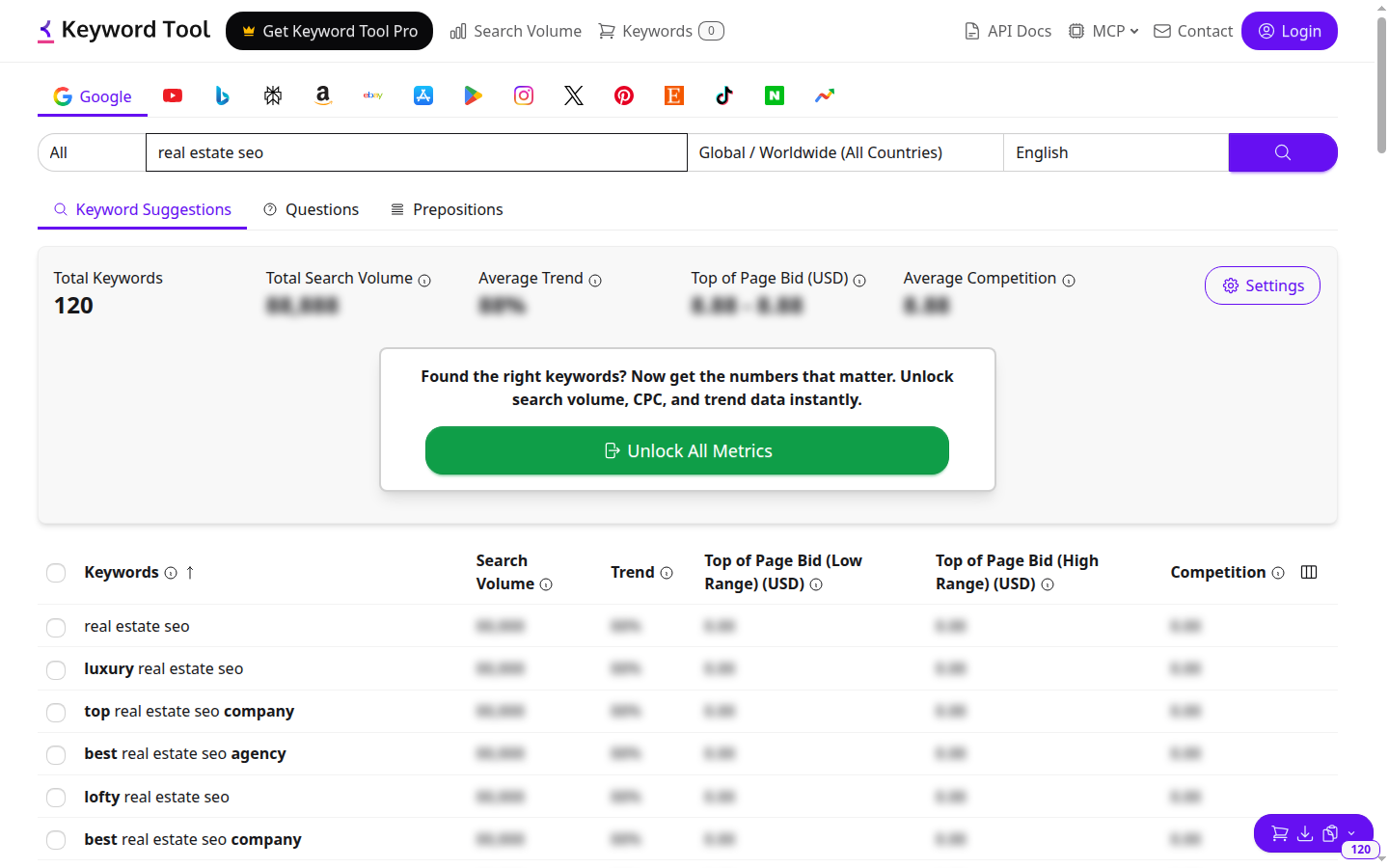
real estate seo, captured August 12, 2026. Suggestions are visible; the metrics required for demand and commercial comparison are not.Keyword Planner has no separate subscription fee, but calling it simply free skips the Google Ads account and billing setup. Its output is still an estimate. That is enough for relative planning when the market and settings are recorded. It is not enough reason to write 22,200 searches as though Google had counted 22,200 distinct people.
Trends and Search Console answer later questions. Trends can show whether interest is seasonal or concentrated in a region. Search Console can reveal the language your own site starts earning impressions for after publication. Neither replaces prelaunch demand measurement.
A paid provider becomes useful when the list is too large to process manually or when you need consistent exports, historical snapshots, and result-page data at scale. Paying for the export does not complete the analysis. It only makes the raw material easier to collect.
Use the search results to decide whether phrases combine
Similar words are not a page architecture. The current results show whether one page can plausibly satisfy both searches.
Consider another real estate cluster:
| Query | Est. US monthly searches | Est. CPC | Exact shared URLs in top 10 |
|---|---|---|---|
google business profile for real estate agents | 210 | $20.32 | 10 |
google business profile for realtors | 90 | $71.71 | 10 |
The volumes and CPCs differ substantially. The top ten URLs are identical. Both phrases ask for the same instructional page, so one guide should own both. Publishing a second Realtor version would not create a second useful answer. It would give the site two pages competing to do the same job.
There is no universal overlap percentage that removes the judgment. Compare the actual URLs, the types of pages that rank, and the job those pages perform. The point of overlap analysis is to expose a decision, not to replace one threshold with another.
Research note: Google Ads search-volume estimates collected for the United States on August 4, 2026; US-English desktop result comparison collected August 3, 2026.
Give every approved cluster one owner
Once the demand and intent are understood, assign the cluster to one URL. Then choose an action:
- Create when useful demand has no suitable owner.
- Keep when an existing owner already performs the right job.
- Rewrite when the correct owner exists but performs the wrong job.
- Merge when several pages divide one job.
- Reject when demand is negligible, the intent falls outside the offer, or the result page requires something the business cannot support.
Calling a URL the owner does nothing by itself. The page needs a reason to be reached from elsewhere on the site and a useful next destination for the reader.
Decide before writing which existing page will send readers to the new owner and where that owner should send them next. Choose the actual sentence and anchor after the prose exists; add other contextual links when research or writing reveals a real reader need.
This preserves both parts of internal linking. The important routes are deliberate; the copy is not distorted to satisfy a prewritten anchor. Google says it uses links to discover pages and understand their relevance, which is why an orphaned owner is not much of an owner at all. Google’s link guidance covers the crawlable implementation.
The minimum useful research output
A list of keywords is an intermediate artifact. The final research sheet needs enough information to make and revisit the decision:
| Field | Question it answers |
|---|---|
| Business and market | Would this traffic be useful to the actual agent, team, or brokerage? |
| Query and close variants | How does the market describe the need? |
| Volume, location, and date | Is there observable demand in the relevant market? |
| CPC or bid range | Is there paid commercial pressure around the query? |
| Current result types | What job must the page perform? |
| Result overlap | Can one page plausibly satisfy the variants? |
| Owner and action | Which URL is responsible, and should it be created, kept, rewritten, merged, or rejected? |
| Minimum link path | How will a reader and crawler reach it, and where should the reader go next? |
That is enough to move from research into writing and preserve why each page decision was made.
After publication, Search Console and lead data get a vote. If the page earns impressions for a different query family, two URLs trade visibility for the same searches, or the traffic never reaches a useful business action, revise the ownership, the page, or the links. The initial research is a decision made from the best available evidence and remains subject to revision.
Where expert help still matters
The spreadsheet can show that two phrases need separate owners; it cannot update the navigation, consolidate an old URL without losing link value, or decide from Search Console whether the split worked. That execution, not access to the numbers, is where an expert earns the fee.
Earnest handles that chain as part of ongoing real estate SEO management. If you want one person to own the research, architecture, implementation, and revision, apply to work with Earnest.
Move from research to implementation. Apply to work with Earnest.
Earnest manages the website, technical SEO, content, local search, authority, and conversion work under one monthly plan.