Luxury Real Estate SEO: What Actually Changes in a Luxury Market
A practical guide to defining the luxury segment, separating search intent, valuing low-volume demand, and handling volatile listings and heavy media.
Luxury is a thin, locally defined slice of a property market. Its economics, volatile inventory, heavy photography, and occasional international demand change the page plan, not the underlying ranking systems.
Use the keyword-research method to separate buyer, seller, and provider searches, the IDX implementation guide for property-page controls, and the general guide for the wider system. Implementation stays inside the same real estate SEO management engagement.
Define luxury before researching it
A national price threshold cannot describe every luxury market. An $800,000 property occupies a different segment in San Francisco than it does in Cleveland.
Redfin’s housing-market methodology defines luxury as the top 5% of each metropolitan market. It calculates the threshold from the previous 12 months of sales and smooths the resulting data because thin segments create noisy monthly figures. That is one defensible research definition. A brokerage still needs a definition that matches the properties and clients it can actually serve.
Start with closed transactions and active inventory in the real market. Determine the price range, property types, neighborhoods or buildings, and side of the transaction the business wants to grow. Then count how much inventory remains after those conditions are applied.
The count changes the page plan. A candidate inventory page needs enough current and recurring property supply to let someone browse. When a filtered segment repeatedly leaves only a handful of properties spread across many neighborhoods, use a broader stable page instead of manufacturing a page for every label.
The same test applies to expertise. A brokerage that represents luxury sellers can support seller guidance with its own process and evidence. A buyer-only operator should not manufacture seller pages because a keyword tool returned the phrase.
One luxury label hides several different searches
Three Miami searches demonstrate the split:
| Search | What the current results let the user do | Appropriate page |
|---|---|---|
miami luxury homes for sale | Browse current properties | Stable market or inventory page populated by live listings |
miami luxury real estate agent | Compare agents, teams, and brokerages; a local business block appears | Homepage or one market-level provider page, depending on whether the homepage already serves that provider search |
sell luxury home miami | Learn how to sell and choose representation | Seller advisory or service page |
The first result set is full of inventory from portals, brokerages, and agent sites. The second begins with providers and local businesses. The third mixes seller guides with pages offering representation. The shared words Miami and luxury do not make those pages interchangeable.
This produces a concrete architecture rule. Decide which page should answer each distinct need. Let an inventory page help buyers browse. Let one provider page establish why the agent or brokerage is qualified. Let a seller page answer the questions that precede representation. If the homepage already handles provider intent for the brokerage’s primary market, a second near-duplicate luxury-agent page merely divides the same demand.
The live result page matters because volume cannot identify the required page type. Measure the demand, inspect what currently satisfies it, and then decide which URL should own it.
Low volume can still support a page
Low-volume traffic is sometimes commercially sensible in real estate. The brokerage’s own unit economics decide it.
Use the brokerage’s own numbers:
expected monthly contribution = impressions × click rate × qualified-inquiry rate × signed-client rate × contribution per client
Every input after impressions must come from the business. A national commission average cannot tell a Miami brokerage what it retains after agent splits, referral fees, marketing costs, and failed transactions. An invented conversion rate cannot tell it how often an organic inquiry becomes signed representation.
The calculation also works in reverse. Enter the actual cost to create and maintain the page, then calculate how many signed clients would recover it. A small query family may pass that test. A larger one may fail when the result page is dominated by inventory and the business only wants seller leads.
Volume still comes first because the calculation needs an observed demand input. It simply does not get the final vote.
Stable pages should carry volatile inventory
Individual listings often disappear faster than an evergreen search plan can mature. Google says recrawling can take from a few days to a few weeks, and a crawl request does not guarantee inclusion. A listing that is active for a short period cannot be the only page responsible for a durable market query.
Use a stable market, property-type, neighborhood, or building page when the research supports it. Current listings populate that page and give the user something real to browse. The page keeps its purpose as individual properties enter and leave the market.
The listing URL then gets an explicit end-of-life decision:
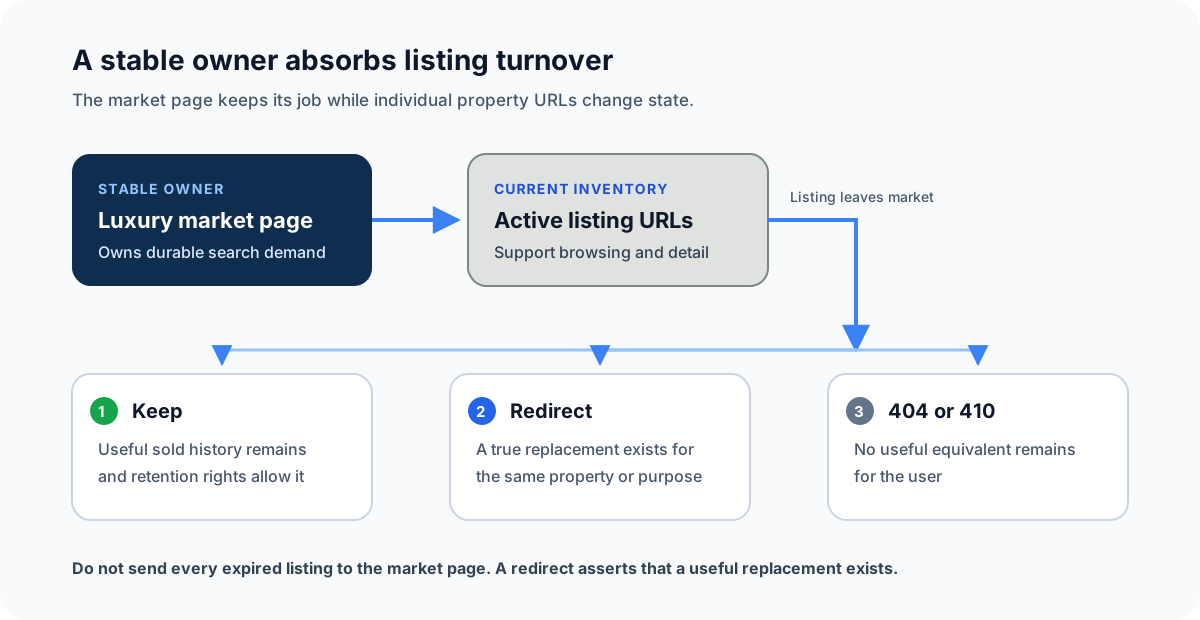
Keep a sold page when the business has the right to retain the information and the page still helps a reader understand the property, building, or market. Redirect when a true replacement exists, such as a duplicate URL for the same property. Return 404 or 410 when nothing useful remains. Sending every expired listing to the market homepage tells a user that a replacement exists when it does not.
Filters deserve the same discipline. Beds, price, amenities, views, waterfront status, and sort order can generate thousands of URL combinations. Google’s faceted-navigation guidance explains how those spaces consume crawling resources and slow discovery of useful URLs. Keep a filtered URL indexable only when observed demand, sufficient inventory, and a stable page purpose justify it. Empty or nonsensical combinations should return a real 404 response.
Photography is content and payload
Luxury property photography has two jobs on the website. It helps a person evaluate the property, and it consumes bytes that the browser must download.
There is no ranking exemption for an expensive photoshoot. The site still needs real HTML image elements, useful surrounding text, descriptive alternative text, responsive source sizes, and compression that preserves the detail a buyer needs. Google specifically notes that it can discover images in an <img> src attribute and does not index CSS background images. Its image guidance also describes responsive sources and the tradeoff between image quality and transfer size.
The practical decision is straightforward:
- Use the commissioned property image when it helps the reader inspect something.
- Describe what the image actually shows in its alternative text when the image carries information.
- Serve smaller files to smaller screens instead of sending the full-resolution original everywhere.
- Keep decorative atmosphere out of the critical loading path.
Keyword repetition in alternative text adds no property detail. A description such as double-height living room facing Biscayne Bay gives a reader and a crawler more information than Miami luxury real estate luxury home for sale.
International pages require observed international demand
Luxury and international are separate conditions. Some U.S. brokerages serve buyers from several countries. Others receive nearly all qualified demand from one metro area.
Check the brokerage’s CRM for actual source markets and Search Console for query, page, and country patterns. Search Console can group performance by query, page, country, and device, although it omits some low-volume and anonymized queries. If qualified demand repeatedly comes from a market the brokerage can serve, then a genuinely localized page may deserve a separate URL and language version.
Translation without market evidence creates another page to maintain and another promise the business must fulfill. When localized versions do exist, Google recommends separate URLs with hreflang annotations so it can connect users with the appropriate version.
Measure whether the page advances the business
Rankings and visits are intermediate evidence. The useful sequence is landing page and query, qualified inquiry, appointment, signed representation, and realized contribution.
Each stage diagnoses a different problem. Impressions without clicks may indicate a weak result snippet or the wrong page type. Clicks without qualified inquiries may expose an audience or offer mismatch. A seller guide with modest traffic and several signed appointments can be more valuable than an inventory page with thousands of visits and no path to the business the brokerage wants.
That is what luxury changes: the market definition, the economics, the inventory constraints, and the value assigned to an outcome. The underlying SEO decisions remain the same.